
Muscle: Simon Reece
Natalie Wilson
Curator | Art Historian
6 May 2026

Installation view of ‘Muscle’ by Simon Reece, 2026.
And from this chasm, with ceaseless turmoil seething,
As if this earth in fast thick pants were breathing,
A mighty fountain momently was forced:
Amid whose swift half-intermitted burst
Huge fragments vaulted like rebounding hail,
Or chaffy grain beneath the thresher’s flail:
And ‘mid these dancing rocks at once and ever
It flung up momently the sacred river
Samuel Taylor Coleridge’s Romantic vision of a subterranean eruption in Kubla Khan (1816) serves as a hauntingly apt threshold for the work of artist Simon Reece. His ceramics are not static objects but the results of such violent, beautiful upheavals, where the earth is never a quiet thing, but a restless participant that breathes and pushes back against our touch. For Reece, working from his studio in Blackheath in the Blue Mountains west of Sydney, clay is never a passive resource; it is a co-conspirator. This follows the pulse of the American political theorist, Jane Bennett, and her proposition in Vibrant matter (2010) that matter possesses ‘thing-power’, a vitality that can alter human intent and demand a seat at the table. In Reece’s hands, the ancient geology of the Blue Mountains and the scarred industrial veins of Muswellbrook are not just subjects for art; they are active agents. Here, the artist does not impose his will upon the world; he ‘intra-acts’ with it.

Simon Reece, time unnoticed (detail) 2026, ceramic, glaze, burnt wood, steel and epoxy.
Within this framework, Reece’s practice enters the realm of political ecology, a field that examines how environmental issues are inextricably tied to political, social, and economic power. By integrating material agency into his work, Reece disrupts the traditional political view of nature as merely a background for human drama or a warehouse of resources. When the clay itself is granted agency, the politics of the landscape shift; we are no longer just managing ‘stuff,’ but negotiating with a living partner. This integration forces a reckoning with how we govern the land. In the Hunter Valley, the political ecology of coal is a story of power lines and profit, but Reece’s ceramics insert the voice of the minerals back into the conversation. His work suggests that a truly sustainable politics must move beyond human-centric laws to acknowledge the rights and ‘thing-power’ of the earth itself, treating degraded mine sites not as a problem to be solved, but as a wounded agent with whom we must reconcile.
The intersection of geological deep time and human industry finds a profound resonance in Reece’s work. In his latest exhibition at Muswellbrook Regional Arts Centre, the artist presents twenty-six works that serve as a bridge between the visceral materiality of the earth and the complex narratives of settlement, extraction, and ecology. Through a multidisciplinary approach, comprising ceramics, photography, and ‘ready-mades’ sourced directly from the Muswellbrook Coal Mine, Reece invites us to reconsider our relationship with the non-human world.
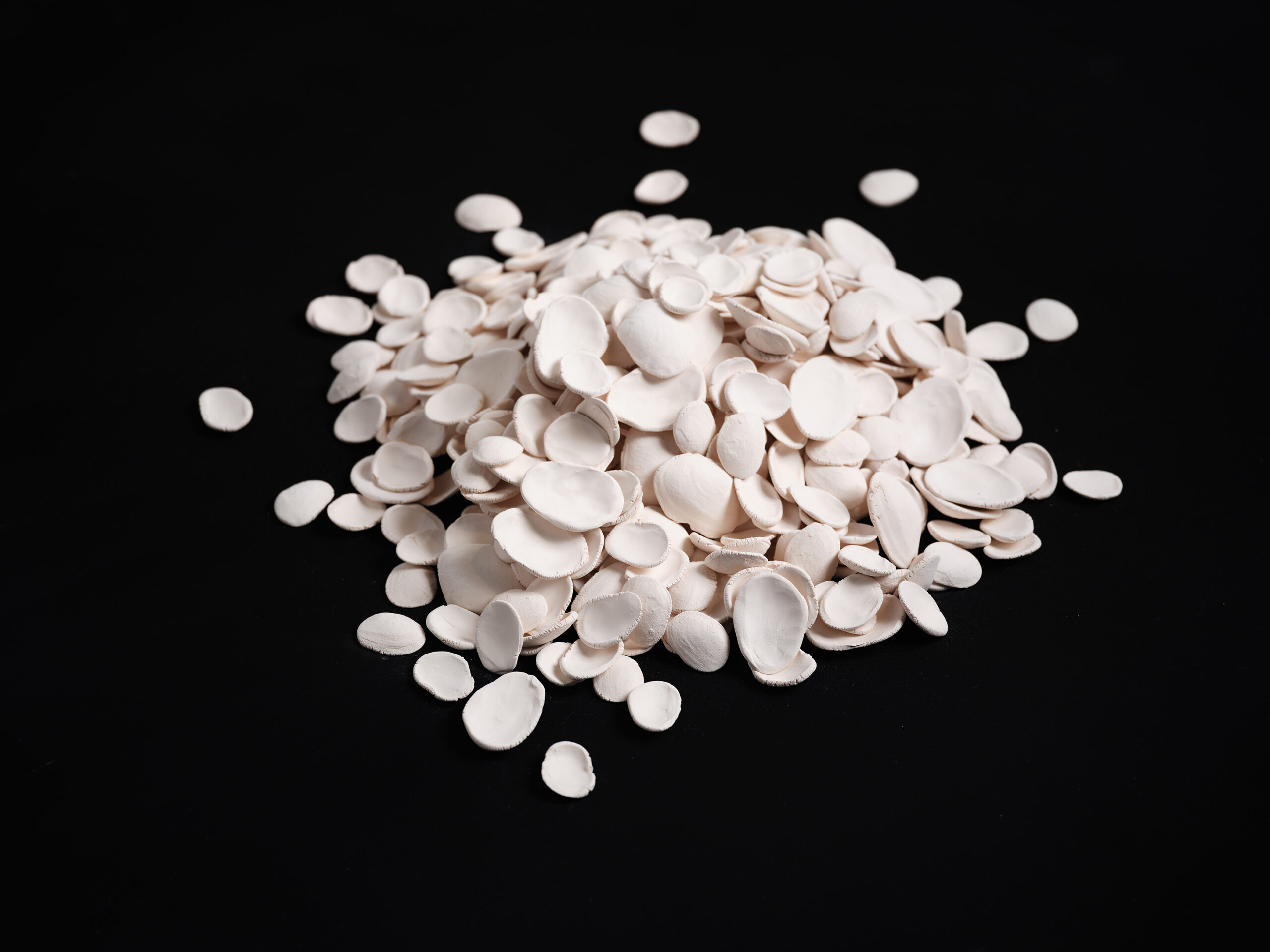
Simon Reece, ‘lime’ – “where’s the midden?” 2026, ceramic, wood and acrylic paint.
To understand the weight of Reece’s work, one must first engage with the specific landscape of Muswellbrook. Known traditionally by the Wonnarua people, the region is defined by the fertile floodplains of the Hunter River. The European naming of the town remains a point of historical curiosity; it is widely believed to be a corruption of ‘Muscle Brook,’ named for the abundance of freshwater mussels (makroo) found in the local creeks. This etymological shift from ‘Muscle’ to ‘Muswell’ mirrors a broader colonial tendency to reshape the land’s identity through language.
The colonial history of Muswellbrook is inextricably linked to the discovery of coal. What began as a pastoral settlement quickly evolved into an industrial powerhouse. The establishment of the coal mines transformed the topography, creating vast voids and artificial bluffs. Reece has previously explored this tension between the natural and the man-made, through his series Flotsam and jetsam (2019), Medusozoans (2016) and Escarpments (2016). However, in this new body of work, he narrows his focus to the specific site-lines of the Hunter Valley, where First Nations history, colonial industry, and geological formations collide.

Simon Reece, Colony – bedded down 2026, ceramic and glaze.
Reece’s engagement with the freshwater mussel is both a nod to the town’s namesake and a tribute to the deep history of the land. Before the mines, there were the shell middens: accumulations of discarded shells that mark centuries of First Nations habitation and sustainable resource management. Reece honours this through the creation of hundreds of clay-cast shells in ‘lime’ – “where’s the midden?”, transforming the biological into the geological. Similarly, in Colony – bedded down, a wall of glazed ceramic mussels represents a collective ‘bed,’ reclaiming the space for the organisms that once defined the river’s health.
This reverence for the small and biological stands in stark contrast to the colossal scale of the mining industry. Reece addresses this disparity in his group of ceramic mining truck wheels, titled big wheel I-IV. By rendering these massive industrial components in ceramic, a material often associated with fragility and domesticity, he subverts their power. The wheels, usually symbols of relentless extraction and forward ‘progress,’ become static, earth-bound totems.
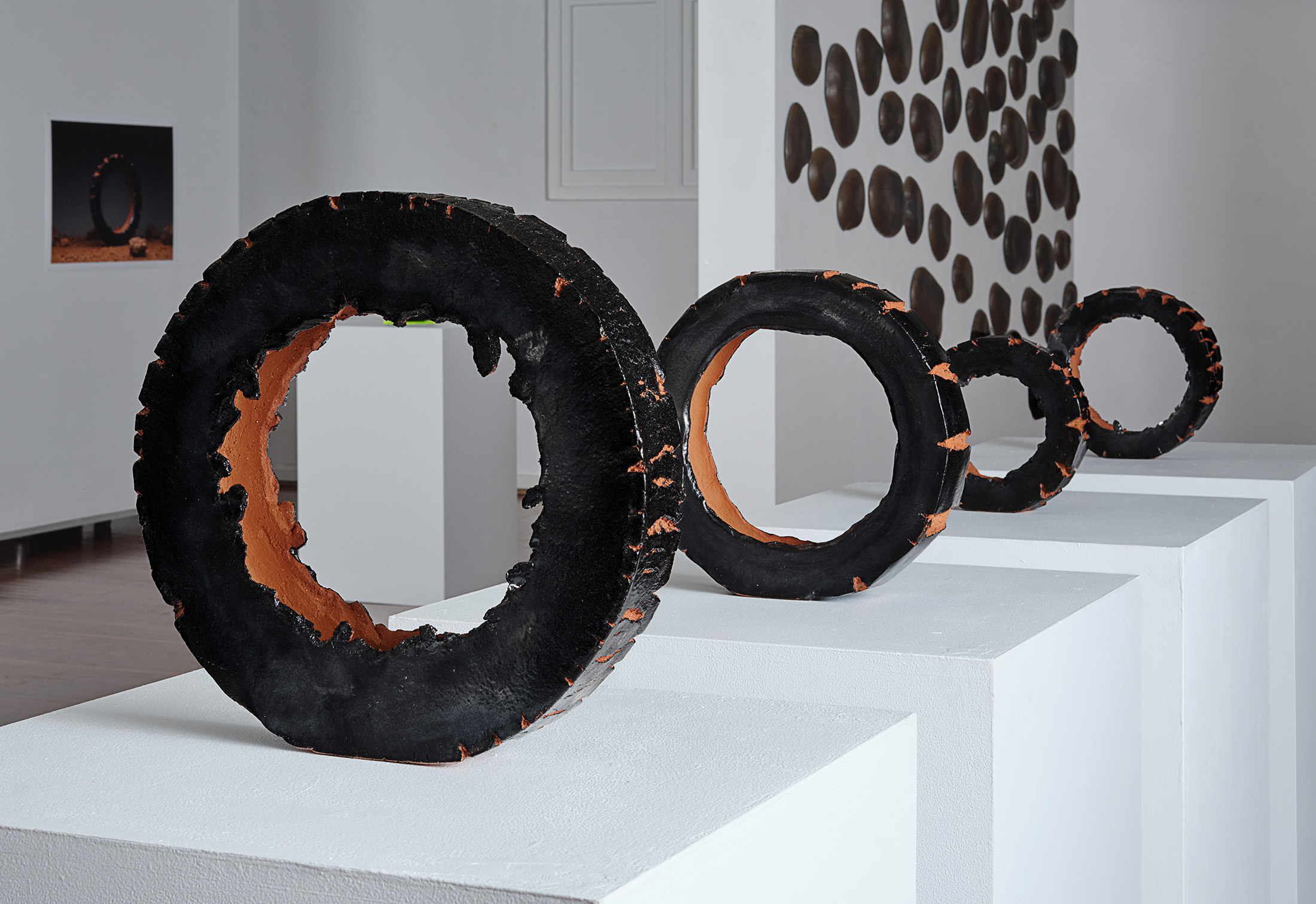
Simon Reece, Installation view of big wheel I – IV 2026 ceramic and glaze.
To stand before an open-cut coal mine is to encounter a modern manifestation of the sublime, that overwhelming sensation where awe and terror meet at the limits of human comprehension. The coal seam itself is a vivid, light-swallowing ribbon, a compressed obsidian of prehistoric sun-energy that invokes a ‘geological sublime’ in its sheer, light-extinguishing scale. It is a wall of fossilised time, millions of years of ancient vegetal decay turned into a dense, oily blackness. In his wall pieces, Big seem and Little seem, Reece translates this geological drama into a stark, visual language: a jet black, vitreous glaze that mimics the obsidian sheen of the coal, set against the raw, unglazed red clay—the dalang. Squeezed between the seams are rows of glazed mussels. The mussels ‘seem’ worthless when contrasted with the economic certitude of ‘black gold’. But at what cost and who makes that call? The wordplay also suggests that these industrial interventions are not just physical cuts into the earth, but part of a social ‘seam’ that holds the town’s history together. It also hints at the ‘seeming’ permanence of an industry that is, in ecological terms, a fleeting moment in the earth’s lifespan.
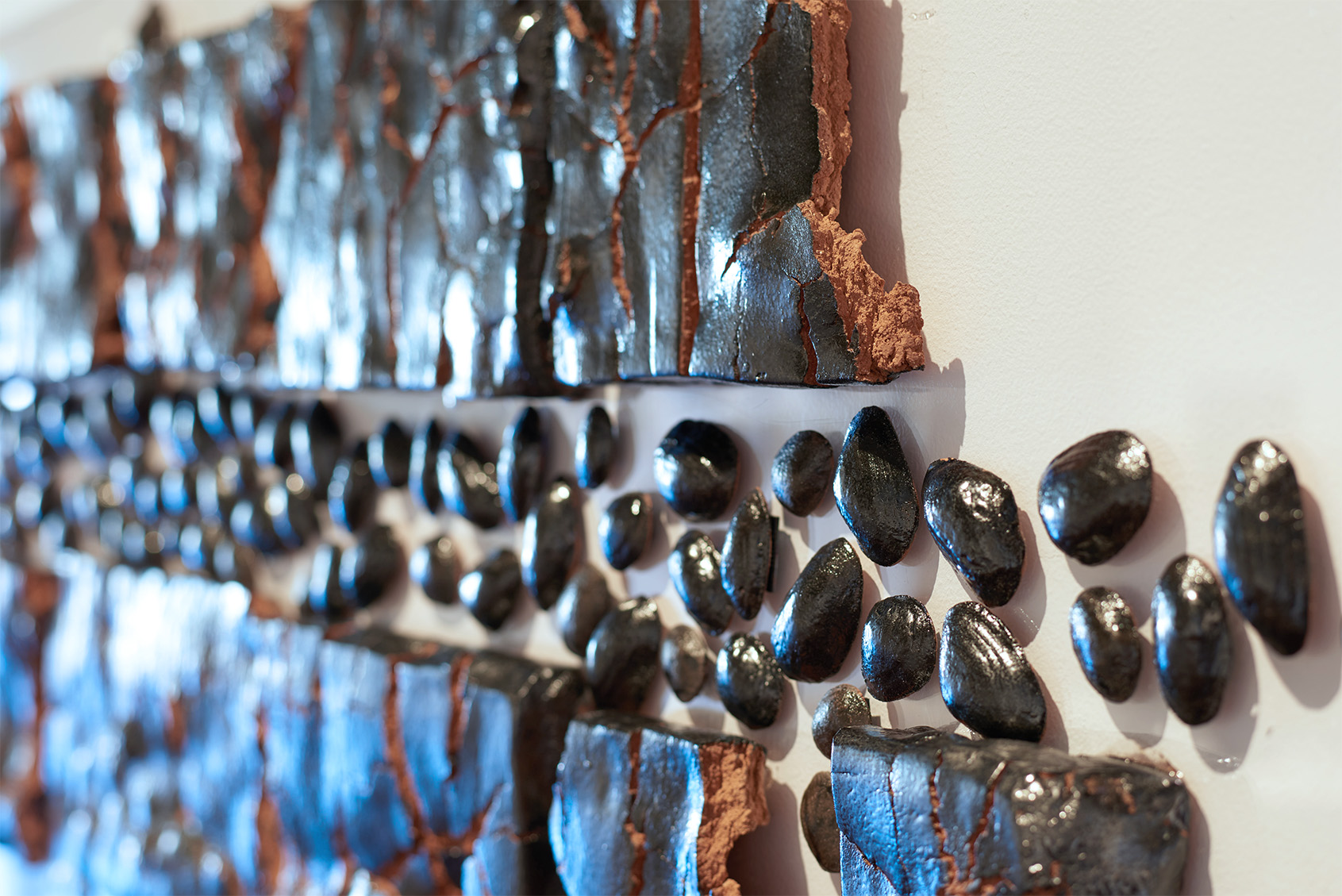
Simon Reece, big seem (detail) 2026, ceramic and glaze.
The dialogue between industry and nature reaches a poetic crescendo in the work Kaeru – T. This piece draws upon Japanese philosophy and the story of the two frogs – one from Osaka and one from Kyoto – who set out to see the world, only to realise that where they came from was just as significant as where they were going. In Japanese, the word ‘Kaeru’ means both ‘frog’ and ‘to return.’ This duality speaks to internal transformation and the cyclical nature of existence. As the viewer approaches Kaeru – T, the sensory experience is heightened by the sound of spotted marsh frogs. The path forward is laid with glazed ceramic stepping stones leading toward a charred railway sleeper. Atop this sleeper sit three chawan (teabowls) made with clay from the Muswellbrook Coal Mine site, embodying the ritual and the stillness of the tea ceremony. Behind this arrangement, a wall piece of deep green glazed ‘frogs’ invites contemplation. These forms are cast from the ‘frogs’, or indentations, found in the town’s local bricks. This mandala-like piece, using arrow–shaped ‘frogs’ (a common mark in colonial brickmaking) leaping randomly across the wall, suggests a spiritual and physical convergence. However, this ‘definition’ flips the soothing narrative of order, reflecting the chaos of return to the natural state. Taming this chaos is impossible, it upends the colonial stasis. The mud of the river, the fire of the kiln, the labour of the brickmaker, and the ancient presence of the amphibian. In Kaeru – T, Reece brings Bennett’s ‘vibrant matter’ to life. The charred sleeper, the ‘frogs,’ and the resonance of the tea bowls all hum with a shared energy. The work suggests that the extraction of coal is not the only way to relate to the earth; we can also extract meaning, beauty, and a sense of return.

Simon Reece, kaeru – T (detail) 2026, ceramic, glaze, burnt wood, Muswellbrook clay, motion sensor, arduino, MP3 and speakers.
Reece’s practice is a testament to the collaborative nature of artistic creation and mentorship. In the studio, the physical toll of working with a multitude of ceramic forms is shared with studio assistant Eleanor Wickens, and assisted by Raymond Huynh, who joined Reece early in 2026 as part of the Foster a Potter program. Their technical support allows the artist’s ambitious visions to manifest. The exhibition is further activated by the atmospheric soundscapes of Damian Castaldi in the works Kaeru – T and Emerge.
This exhibition is a call to listen to the ‘thing-power’ of Muswellbrook. From the ancient shell middens to the massive voids of the coal mines, Reece shows us that the environment is not a backdrop for human drama, but a lead actor. By casting the local landscape in clay, he fixes a moment in time where the industrial and the ancestral meet. Reece reminds us that whether it is a ‘big wheel’ or a single mussel shell, all matter is vibrant, all matter is storied, and all of it demands our care and attention. This collection of works does not just represent the Muswellbrook area; it vibrates with it.
READ more
The READ Archives
- 2026 Finalists Announced for the 2026 Muswellbrook Art Prize
- June 2025: Fiddling while Rome burns by Tracey Clement
- June 2025: BECOMING JULIE VISIBLE and THE CAROUSEL OF INVISIBILITY by Steven Cavanagh
- Finalists Announced for the 2025 Mullins Conceptual Photography Prize
- May 2022: Q&A with the Winner of the 2021 Mullins Conceptual Photography Prize, Ian Skinner
- July 2022: On Conceptual Photography by Alex Wisser
- September 2022: Artist’s creative spirit took flight in Upper Hunter by Laurie Sullivan
- December 2022: On Art Prizes by Dr John Barnes
- September 2023: A Field Guide to Abstraction in the Muswellbrook Collections by Brad Franks
- August 2024: LiddellWORKS Opening, Muswellbrook Regional Arts Centre, by Rob Cooper
